
Systems thinking has become one of those terms that appears in every healthcare leadership conversation without meaningfully changing how decisions get made. It is in strategic plans, conference keynotes, and organizational values statements. It is cited as the reason why an initiative was launched and as the explanation for why a previous one failed. It has become, in many organizations, a concept that everyone endorses and almost nobody practices.
This is not because people are insincere. It is because the version of systems thinking that has entered common usage is a significantly diluted one. And the gap between the popular version and the actual discipline is where most healthcare innovation programs lose their footing.
In a [previous post](ecosystems.desikanadadur.com), I wrote about why healthcare innovation keeps failing at scale. Systems thinking, properly understood and applied, is a significant part of what changes that outcome. This post explores what it actually means, what it requires, and why it is harder to practice than to understand.
The definition that actually matters
Systems thinking is the discipline of understanding a situation by examining the relationships, feedback loops, and interdependencies among its parts, rather than analyzing those parts in isolation.
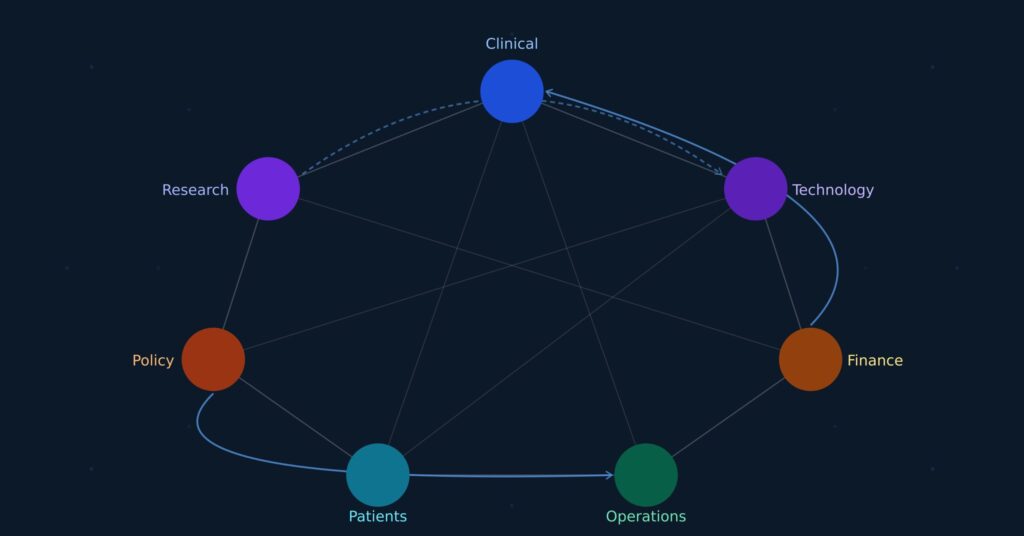
The word that carries the most weight in that definition is feedback. A system is not just a collection of components with connections between them. It is a set of relationships that generate behavior over time, behavior that often surprises the people who designed the components because they did not account for how the components would interact with each other and with the broader environment.
Healthcare is full of these feedback dynamics. The problem is that most organizations are designed and managed to optimize within domains rather than across them. Clinical leadership optimizes for clinical outcomes. Finance optimizes for cost and margin. Operations optimizes for throughput. Technology optimizes for system uptime and integration. These are all legitimate and necessary functions. But when they operate without structured visibility into how their decisions affect each other, the result is a system that produces outcomes no one intended and that no single department has the authority or information to address.
This is not a people problem or a leadership problem in the conventional sense. It is a structural problem. And structural problems require structural diagnosis, which is what systems thinking is designed to provide.
Why “thinking about the whole system” is not enough
The popular version of systems thinking essentially means: remember to consider the broader context, do not focus too narrowly, involve multiple stakeholders. This is reasonable advice. But it is not systems thinking in the sense that produces different outcomes.
The distinguishing element is the shift in the question being asked. Linear thinking asks: what is the problem and what is the fix? Systems thinking asks: what patterns of structure, incentive, culture, and behavior are producing this outcome, and what would need to shift to change those patterns?
The first question sends an organization toward a solution. The second sends it toward a diagnosis. And one of the most consistent findings across failed healthcare innovation programs is that the solution arrived before the diagnosis was complete.
The EHR story illustrates this clearly. Electronic health records were introduced to improve care coordination, reduce documentation errors, and give clinicians better access to patient information. The technology worked as designed. What went wrong in many organizations was that the implementation failed to account for the workflow, relational, and cultural dynamics that would determine how the technology actually functioned in practice. Administrative burden increased. Clinician time with patients decreased. The feedback loop between those two outcomes produced precisely the kind of morale and retention pressure that the system was not designed to handle.
This was predictable in retrospect. A systems thinking approach asks precisely the questions that would have surfaced those dynamics before deployment rather than after.
The “fixes that fail” pattern
The organizational theorist Donella Meadows named a recurring pattern in complex systems that she called “fixes that fail.” The pattern works like this: a problem emerges, a solution is applied that addresses the visible symptom, the symptom improves temporarily, but the underlying dynamic that produced the symptom continues operating and eventually reasserts itself. The fix does not fail immediately. It fails over time, often in a way that makes the root problem harder to address than it was before.
Healthcare innovation is full of this pattern. A system struggles with care coordination, so a coordination team is added. The coordination team creates new handoffs and bottlenecks. The original fragmentation continues but now has an additional layer of organizational overhead around it. A different system implements new scheduling software without addressing the upstream referral flow that drives scheduling demand. The software works correctly, but wait times do not improve because the problem was never in the scheduling system itself.
These are not failures of intention or effort. They are the predictable outcome of applying linear problem-solving to systemic challenges. When the fix addresses the symptom rather than the structure, the structure eventually reasserts itself.
Five things systems thinking is not
The gap between the concept and its practice is wide enough that it is worth naming some of the ways it gets misunderstood, because each misunderstanding leads to a different kind of failure.
Systems thinking is not process mapping. Process mapping is a useful tool and can be a component of systems analysis, but it documents how things currently work without necessarily illuminating why they produce the outcomes they do. Systems thinking focuses on the feedback loops, mental models, and interdependencies that drive the behavior of a process over time, not just its current state.
Systems thinking is not too abstract for urgent environments. This is one of the most common objections, and it gets the trade-off backwards. Applying linear fixes in urgent situations often creates the downstream complexity that produces the next crisis. Structured approaches to identifying leverage points can be scaled to the time available. A quick causal mapping session with a cross-functional team often reveals the relevant dynamics faster than several cycles of trial and error.
Systems thinking is not only for large, complex initiatives. It is equally applicable to small team decisions and pilot program design. Wherever interdependencies exist, wherever a change in one domain will affect conditions in another, systems thinking is relevant.
Systems thinking is not a planning methodology that gets applied once at the beginning of an initiative. It is a continuous practice, woven into decision-making, strategy review, and course correction throughout an initiative’s lifecycle. Organizations that apply it only at the outset and then revert to linear management are not practicing systems thinking. They are using it as a planning ritual.
And finally, systems thinking is not the exclusive domain of analysts or academics. Clinicians, program managers, and executives at every level can apply it in ways that are directly relevant to their specific role and context, provided they have the frameworks and language to do so.
What changes for organizations that practice it seriously
The organizations that practice systems thinking as a discipline rather than a vocabulary tend to share a set of structural characteristics.
They have mechanisms for cross-domain visibility—ways of seeing how decisions in one part of the organization create conditions in another. They treat feedback not as an evaluation tool but as a design input, using what they learn from each phase of an initiative to inform the next. They build what I think of as Feedback Capital: the accumulated learning from how their interventions have behaved over time, which makes each successive initiative faster to diagnose and better designed from the start.
They also invest in what the book I have been writing calls Institutional Intelligence, the organizational capacity to continuously sense, interpret, and respond to system-wide patterns rather than reacting to local symptoms. And they recognize that this capacity depends on an Ecosystem of Trust—the relational, behavioral, and governance conditions that make it possible for information to flow across boundaries, for disagreement to surface safely, and for decisions to be made with the full picture rather than a departmental slice of it.
These three concepts—Feedback Capital, Institutional Intelligence, Ecosystem of Trust—are not independent ideas. They are mutually reinforcing conditions that, together, describe what a systems-thinking organization actually looks like in practice. Understanding them separately is straightforward. Building them together, within the constraints of a real healthcare organization, is the work.
The practice behind the vocabulary
The point of this is not to make systems thinking feel inaccessible. It is to be honest about what separates organizations that use the language from organizations that get the outcomes.
The vocabulary is easy to adopt. The practice requires structural changes: in how decisions are governed, in how problems are diagnosed before solutions are designed, in how learning is captured and carried forward, and in how the people doing the work are supported across the organizational boundaries that currently separate them.
What that practice looks like, and how it translates into a methodology that can be applied at the level of a real initiative inside a real healthcare organization, is the subject of the work this site is built around.
The ideas in this post are developed in depth in my book, Designing Healthcare Innovation Ecosystems: A Systems Thinking Framework for Coherent, Human-Centered, Value-Driven Transformation. The book moves from the conceptual foundation described here into a structured, phase-based methodology that embeds systems thinking across the full innovation lifecycle. For organizations working through these challenges in real time, I also work directly with leadership teams to apply this framework in context. If either is relevant to where you are, I would welcome the conversation.