
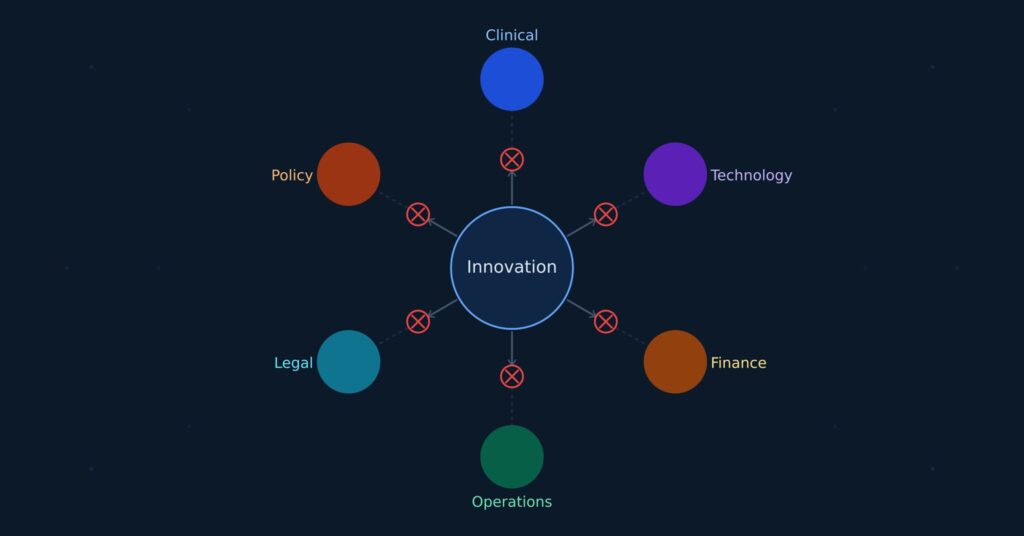
Despite record investment, a growing ecosystem of startups, and genuine commitment from people across the industry, most healthcare innovation programs fail to achieve meaningful scale. The ideas are often sound. The people behind them are talented and motivated. The problem runs deeper than either.
This is something I’ve spent years trying to understand. And the more I’ve studied it, the more convinced I’ve become that healthcare doesn’t have an innovation problem. It has a systems problem.
The Investment Paradox
The scale of investment in healthcare innovation is staggering. In 2021 alone, digital health funding in the US reached over $29 billion, according to Rock Health’s annual venture report. Thousands of startups. Hundreds of hospital innovation programs. Countless pilots and proofs-of-concept, many of them technically impressive and clinically valid.
Most of them quietly collapsed.
A 2022 HIMSS survey found that over 60% of healthcare executives reported failed or abandoned digital initiatives, with misalignment with clinical operations and lack of implementation readiness cited as the leading causes. That’s not a startup problem or a technology problem. That’s a structural one.
When the majority of well-funded initiatives in any industry fail for the same repeating reasons, the industry isn’t facing bad luck. It’s facing a pattern. And patterns have causes.
Invention Is Not Innovation
The first thing I had to unlearn was the assumption that generating a good idea is the hard part.
Invention is the creative act of producing something new: a tool, a clinical approach, a workflow redesign. Healthcare is genuinely exceptional at invention. The volume and quality of ideas flowing through academic medical centers, startups, and health system innovation labs is remarkable.
Innovation is something harder and more organizational. It is the structured work of embedding a new idea into a system that can absorb it, align around it, and sustain it over time. It requires different skills, different processes, and a different kind of organizational commitment than invention does.
When healthcare organizations treat innovation as if it were a faster, better-funded version of invention, they set themselves up to fail. The gap between a successful pilot and a scaled solution isn’t a gap in ideas. It’s a gap in readiness, governance, alignment, and design.
The Fragmentation Problem
Here is what structural failure actually looks like in practice.
An AI-powered radiology tool doesn’t just need to work technically. Deploying it successfully requires changes in image capture workflows, IT infrastructure, regulatory approvals, and billing codes. Those changes cut across radiology, IT, finance, legal, and clinical operations. In most health systems, those departments don’t coordinate in any structured way during implementation. Each one optimizes for its own constraints, its own timelines, its own definitions of success.
The result is a well-designed solution that technically works and operationally fails.
This pattern repeats across domains. Telehealth platforms built without adequate integration into scheduling systems. Patient communication tools deployed without clinical workflow redesign. Population health programs launched without the data infrastructure to support them.
This is what misalignment looks like. And critically, it is not a people problem. The individuals involved in these failures are usually doing their jobs competently within their own domains. The failure lives in the space between domains, in the absence of coordination structures that don’t exist yet.
Symptoms Versus Root Causes
One of the most costly habits in healthcare innovation is treating symptoms as if they were the root problem.
When an innovation program struggles, the explanations that surface are usually symptomatic: low adoption rates, budget overruns, missed timelines, staff resistance. Leadership responds by addressing those surface signals — more training, tighter project management, change management campaigns.
These interventions are not wrong. They are just aimed at the wrong level.
In every case, the surface symptom points back to a deeper systemic cause. The failure to diagnose at that level, rather than responding to what’s immediately visible, is one of the most expensive habits in healthcare innovation. It’s the organizational equivalent of treating fever without identifying the underlying infection. The fever may temporarily subside, but the condition persists and compounds.
What makes this particularly difficult is that the diagnostic work required to surface root causes is not intuitive. It demands a different kind of inquiry than most organizations are structured to do, one that crosses departmental lines, challenges existing assumptions, and resists the pressure to move quickly to solutions.
The Compounding Effect of Innovation Fatigue
This is where things get particularly costly, and where I think the healthcare industry significantly underestimates the damage being done.
Every failed innovation initiative leaves a residue. Staff who were asked to support a program that went nowhere carry that experience into the next one. Enthusiasm erodes. Engagement becomes more guarded. When the next initiative launches, people begin protecting themselves from disappointment rather than investing in the outcome.
The Gartner Hype Cycle describes how early excitement around innovation is reliably followed by disillusionment when results don’t materialize on the expected timeline. In healthcare, that disillusionment compounds across cycles, creating what might be called defensive disengagement: a state where people go through the motions of supporting innovation without any genuine belief that it will succeed.
The National Academy of Medicine has described clinician burnout as a systems-level problem driven by poor process design, conflicting technologies, and constant interruptions. What belongs in that picture is the additional burden of repeated, poorly implemented change initiatives that consume time and generate little visible benefit.
Innovation fatigue isn’t a morale problem. It is a direct consequence of a missing methodology.
The Deficit That Doesn’t Get Named
There is a concept I find essential for understanding why this pattern persists, which I call Institutional Intelligence.
It refers to a form of organizational capacity that most health systems have not deliberately built. Something distinct from clinical expertise, technical capability, or financial acumen, though it depends on all three. When it’s present, organizations can absorb new initiatives without breaking what already works. When it’s absent, even well-designed innovations with strong executive sponsorship struggle to survive contact with organizational reality.
Most health systems don’t know they’re missing it until an initiative fails in a way that can’t be explained by the quality of the idea or the talent of the team. That’s usually the moment the real diagnosis begins.
Why This Moment Is Different
There is a reason this conversation feels more urgent now than it did a decade ago.
The COVID-19 pandemic forced healthcare organizations to innovate at a pace and scale they had never previously attempted. Telehealth adoption happened in weeks rather than years. Remote monitoring programs stood up rapidly. Triage and care delivery models changed almost overnight.
What the pandemic also exposed was the fragility of ad hoc innovation. The solutions that scaled fastest were often the ones that created downstream complexity: incompatible platforms, workflow disruptions, equity gaps, and sustainability challenges that organizations are still navigating.
The pandemic accelerated transformation. It didn’t make transformation more coherent. And the convergence of continued technology maturity, value-based reimbursement pressures, workforce challenges, and regulatory shifts means the pressure to innovate is not receding. What’s needed is not more innovation energy. There is no shortage of that. What’s needed is a more rigorous, more systemic approach to how innovation actually happens.
What Changes When You Treat Innovation as a System
The organizations that navigate this well are recognizable not because they have more resources or better technology, but because they ask a different set of questions before any initiative begins.
Instead of starting with “what solution should we build,” they start with “what does the system actually need, and is it ready to receive change.” Instead of measuring success by whether a pilot launched, they measure it by whether the surrounding organization shifted in ways that make the next initiative more likely to succeed. Instead of treating implementation as a downstream concern, they treat it as a design constraint from the beginning.
This reorientation changes everything that follows. It changes who gets involved and when. It changes what gets measured and why. It changes how teams are structured, how decisions are governed, and how organizations build the memory and learning capacity to avoid repeating the same failure patterns across successive initiatives.
The shift is not primarily about adopting a new methodology, though methodology matters. It’s about developing a new kind of organizational literacy around innovation, one that treats complexity as a design condition rather than an obstacle, and that builds coherence across the clinical, operational, financial, and human dimensions of change.
Organizations that reach this point don’t just launch better pilots. They build the kind of environment where good ideas have a genuine chance of becoming lasting improvements. That is a fundamentally different outcome than what most innovation programs are currently designed to produce.
Understanding what that environment looks like, and how to build it deliberately within the constraints of a real healthcare organization, is the work this site is dedicated to exploring.
The ideas in this post are drawn from my book, Designing Healthcare Innovation Ecosystems: A Systems Thinking Framework for Coherent, Human-Centered, Value-Driven Transformation. The book develops these themes into a full methodology, covering how to diagnose systemic readiness, how to design across organizational boundaries, and how to build the governance and learning structures that make innovation sustainable. For organizations working through these challenges in real time, I also work directly with teams and leadership to apply this framework in context. If either is relevant to where you are, I’d welcome the conversation.